
Precision & Performance
Engineering Instruments for Superior Outcomes
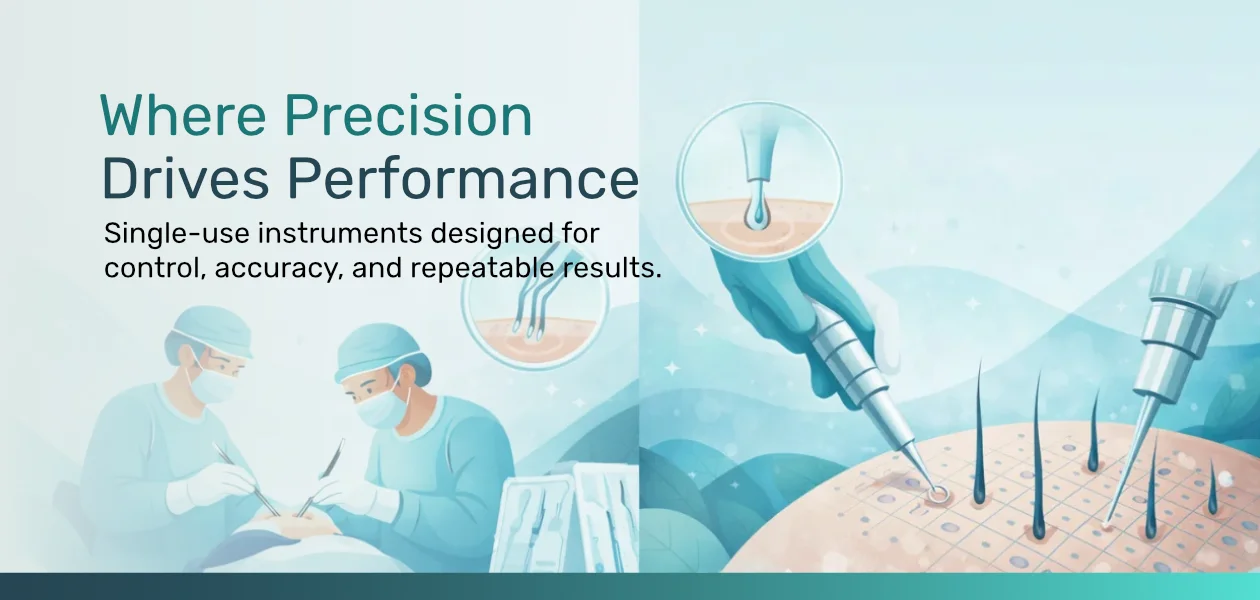
Precision Instruments for Hair Restoration Surgery

Precision Instruments for Hair Restoration Surgery

In hair restoration surgery, every millimetre matters. From follicle extraction to graft placement, precision determines the aesthetic outcome and the long-term viability of each graft. That’s why the choice of precision instruments for hair restoration surgery and hair transplant surgical instruments more broadly is not just a technical consideration — it’s a strategic one.
Precision Instruments for Hair Restoration Surgery set the standard for consistency, control, and predictable clinical outcomes.
At Link Surgical Instruments, we believe that precision begins with design. Each instrument we manufacture is engineered for surgical control, ergonomic balance, and absolute consistency — empowering surgeons to perform at their best in every procedure.

The Science Behind Precision

Hair restoration is a microsurgical discipline. This demands microsurgical hair restoration tools that support accurate follicular unit handling while minimising tissue disruption.
Whether performing FUE (Follicular Unit Extraction) or FUT (Follicular Unit Transplantation), surgeons rely on FUE surgical instruments and FUT surgical instruments that deliver uncompromising accuracy while reducing tissue trauma.
Reusable instruments used in Precision Instruments for Hair Restoration Surgery can, over time, lose edge integrity or develop subtle deviations that affect performance. Even a fraction of a millimetre in tolerance can influence graft transection rates or placement accuracy.
Compared with reusable systems, single-use hair transplant instruments are engineered to eliminate variability and support consistent clinical performance. Single-use precision instruments offer:

By contrast, single-use precision instruments offer:

This is the engineering of confidence — precision built into every component.

Understanding Surgical Performance: Beyond the Blade

Performance is more than sharpness. It’s about how an instrument feels, responds, and delivers consistency across multiple passes.
Key Performance Factors:
By refining these attributes, Link Surgical Instruments enhances surgical efficiency and ensures surgeons can operate with absolute precision and control.

The Role of Instrument Design in Hair Transplantation

Each phase of a hair restoration procedure relies on purpose-built, precision-engineered surgical tools designed for consistency and control. From punches and forceps to implanters and blades, the right design determines the smoothness of every extraction and placement.
Example Applications:
Every single-use instrument in the Link Surgical range is pre-sterilised and optimised for repeatable performance, ensuring surgeons can focus entirely on patient outcomes rather than equipment variability.

Why Sharpness Equals Success

Precision Instruments for Hair Restoration Surgery are essential for reducing tissue trauma and supporting long-term graft survival.

The sharper the instrument, the cleaner the incision — and the cleaner the incision, the higher the graft survival rate. Maintaining a high graft survival rate depends on clean incisions, minimal compression, and controlled tissue interaction throughout the procedure.

Dull or damaged reusable instruments can increase graft transection, compromise blood flow, and lengthen healing times.
Single-use precision instruments for hair restoration surgery, retain their factory-sharpened precision from the first incision to the last, enabling surgeons to achieve:
Precision directly translates into performance — and performance into superior results.

Engineering Excellence, Verified at Every Stage

Link Surgical Instruments adheres to international medical device manufacturing standards, including:
These certifications confirm that every instrument meets the requirements expected of medical-grade surgical instruments used in regulated clinical environments.
Each instrument undergoes stringent quality inspection to ensure dimensional accuracy, edge integrity, and surface cleanliness, all verified under magnification and documented for traceability.
This level of detail is not optional — it’s fundamental to achieving surgical excellence.

Consistency Without Compromise

Surgeons who perform high volumes of hair transplant procedures need tools that perform identically every time. Reusable sets introduce small but cumulative variations in sharpness, torque, and friction — factors that impact both speed and precision.
Single-use instruments remove these inconsistencies entirely. Each one is identical in specification, sterilisation, and performance — a replicable standard of surgical precision across every operation. This ensures that the results of one procedure can be confidently replicated in the next.

Precision in Practice: Surgeon Feedback

Clinics that have transitioned to single-use surgical instruments report measurable improvements in:
In the words of one experienced practitioner:

The consistency of single-use instruments has transformed our workflow. Every punch feels exactly as sharp as the first — and our patients benefit from faster recovery and better results.

At Link Surgical Instruments, this level of feedback drives continuous innovation — refining design, performance, and usability based on real-world surgical experience.

Why Choose Link Surgical Instruments

We engineer every tool with one goal in mind: to support surgeons in achieving superior outcomes.

Surgical excellence begins with instruments engineered for precision.

Frequently Asked Questions about Precision Instruments
Precision instruments for hair restoration surgery ensure cleaner incisions, reduced tissue trauma, and higher graft survival rates. By delivering consistent accuracy, they help surgeons achieve natural-looking results and faster patient recovery.
Yes. Single-use precision instruments maintain factory-sharp edges and eliminate performance degradation caused by repeated sterilisation. This consistency supports superior outcomes in both FUE and FUT procedures.
Precision-engineered punches, forceps, and blades reduce transection, minimise handling trauma, and support clean graft placement. This leads directly to improved graft viability and long-term hair growth.
Surgeons should prioritise sharpness, ergonomic balance, tactile control, and strict dimensional accuracy. These features improve control during extraction and placement, enhancing both speed and surgical precision.
By delivering consistent sharpness and smooth cutting performance, precision instruments reduce resistance, limit fatigue, and improve procedural flow — allowing surgeons to maintain accuracy over long operating sessions.
🔑 Key Takeaway:
Superior hair restoration outcomes begin with precision-engineered, single-use instruments. By eliminating performance variability, maintaining factory-sharp edges, and supporting ergonomic control, these tools enable cleaner incisions, higher graft survival, and more consistent surgical results — empowering surgeons to operate with confidence, accuracy, and efficiency in every procedure.

Precision instruments for hair restoration surgery are the bridge between surgical intention and surgical outcome. When every tool performs flawlessly, excellence becomes repeatable.

0

Your Cart

Your Cart Is Empty

link-surgical-favicon
Privacy Overview

This website uses cookies so that we can provide you with the best user experience possible. Cookie information is stored in your browser and performs functions such as recognising you when you return to our website and helping our team to understand which sections of the website you find most interesting and useful.